" The Five Preludes of 1940
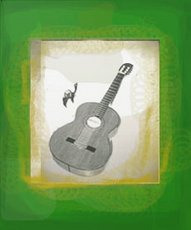
. which vary in character, key, tempo and mode of playing, also show that the composer had not forgotten what he had learnt from the guitar-playing popular musicans" ( From the backcover of the LP "Julian Bream plays Villa-Lobos" - picture is part of the frontcover. It was realeased on RCA, recorded in England, I think in the early seventies. Heitor Villa-Lobos (1887-1959) is one of the world wide known composers of Brazilian music, and Julian Bream; one of the great inspired recording artist´s and messengers of our time in the field of classical guitar.
I have always felt that the recorded documents are of significant importance. More from the cover of this particular LP, about the composer Villa-Lobos; "Born in 1887 in Rio de Janeiro, he was only twelve years when he started playing in coffe-houses and, out of opposition to an academic type of tuition, gained his training on autodidactic basis. His actual "teachers" came from the ranks of popular musicians, who taught him guitar improvisations, melody and modulation of the "choro", a genre played in the open air by an instrumental ensemble". (Unfortunately I don´t have the name of the artist who did the frontcover picture, but I think it was extraordinary for the time, in the idiom of classical guitar. The text backside was written by Uwe Kraemer, in german, but also translated to english/ french.)
In my mind Brazil is one of the great music countries, and specially of course from the guitarists point of view. There is "everything"; the lyrical (some portugese...), black music (rhythm....),developed extended harmony, loved by jazz musicians. The three classical elements; "melody, rhythm and harmony". At least from geographical distance (I´ve never been outside Europe), it seems that all elements live happily together. The ethnic music is very vital, and influental, world known by it´s rhythmical chemistry. We even talk about brazilian footballplayers as artists of "samba-football".
Writer, guitarist and arrangeur Brian Hodel in an old article (Guitar - magazine, I think it was published in the late seventies) : "No account of Brazilian guitar music can omit Joao Gilberto. Though primarily a singer, it is his batida de samba (literally: "drumming on the guitar") which most Brazilian musicians consider the essence of the bossa-nova. Though many guitarists were working in the same direction, it was Joao with the 1958 succes of "Bim Bam" and "Desafinado" (A.C.Jobim), who popularized the style, and, along with Jobim, became the centre of a group of musicians inhabiting Rio´s Zona Sul who developed the bossa-nova into a definite form. (The Zona Sul is the southern part of Rio that includes the famed beach sections of Copacabana, Leblon and Ipanema.) Though the bossa-nova was never popular success in Brazil, it became so throughout most of the rest of the world beginning in the mid 60s. Why did the batida de vioalao revolutionize Brazilian guitar playing? As Baden Powell explains it: "Prior to this style of playing, samba was played with the entire right hand strumming up and down so that the guitarist had very little freedom to add a melody to the chords or a separate bass part. But the batida de violao allowed the guitarist to play like the classical performer with the right hand in position where it could function in more complex manner".
Fortunately I had the opportunity to experience Baden Powell in concert in Helsinki about thirty years ago. The headline in the newspaper the day after reported; "Happy Guitar (-ism or -playing; in finnish: "Onnellista Kitarointia") I agree, it was soft, cool, lyrical, rhythmical......, with amazing contact with the instrument and through that, with the audience. He didn´t talk too much, no jokes between the pieces..., he felt serious all the way. It was a full time solo performance, no group around him, which would make it easier to find the platforms of polyrhytmical grooves, when it´s needed. I´ll never know how much of his performance was improvised. (Good improvisers may sound like they play composed music all the way).
When studying the written music, for example arrangements of brazilian standards, it is important to remember; ..."what is written is not the whole truth". You must learn fundaments of the written idea properly,.. but then comes the question of of accents, understanding of the idiom, what freedom is possible to take and so on, like the more tutorial approach to jazz. You normally can´t play jazz themes like military music from southern Germany, and more less improvise over it that way, like Bobby the Robot (or "Raw Bath", from one Spike Jones record, it has nothing to do with my article)
Much of the modernism in the brazilian guitar, includes, beside the rhythmical essence, "mystical" chords ...., it´s part of it. Anyway, with some experience and finger playing conditions, it´s not so difficult "sound brazilian". It´s maybe compareable to, "it´s not diccult to sound "spanish". But then, from there, from the first humbug level........ Not so many decades ago it was not easy to find out, for example in northern Europe, how the stories go on. Thanks to the records of course, but also to the tutorial books, made by "insiders", much information is available.
In the case of studying brazilian guitar music, I occasionally some years ago found Nelson Faria´s book in music school library. It was very satisfying to read, and get some witness, and listening (CD included) to the small differencies involved in brazilian popular traditions. In Europe everything seemed to be just bossa-nova or samba...., sometimes even without that difference, "play some latin you idiot" (scene in restaurant ). For example; Nelson Faria gives examples of subivisions in the samba; Samba enredo, Samba cancao, Samba de breque, Partido alto, Batucada, Samba Funk. The Bossa Nova is of course something else. Beside that we have the Choro (many pieces are found in the older tradition and composition, sometimes also known by strictly classical guitarists). We also have other stylings as; Frevo and Baiao.
Nelson Faria also gives lot of names in selected discography and lists of important names in the different styles. One of the great brazilian guitar personalities mentioned is Laurindo (de) Almeida, highly important for the brazilian guitar links towards U.S. (since 1947). By occasion I happened to hear Laurindo Almeida with other (very) established musicians from the Los Angeles area, in 1970ies. This was in Malmoe (for swedish beer drinking readers; it´s in the same direction as your feet, if you lay down on the asphalt with your head in the direction of the north-pole). The performance was in a way, from the public point of view, very undramatic. My picture was that Laurindo Almeida&Co was meant to perform in Copenhagen, but by some positive reason also did it, with not flashingly much advertisement, in an small simple restaurant (with red-white chequered cloths and squeeking chairs) nearby.
I think that the written commercially available arrangements or compositions of Brazilian, at least influenced, have been important for the knowledge of Brazilian guitar over the world, not just the sounding records. In the european music and it´s educational traditions, the analyze, at least the possibility to do it, is often proof for establishment. It´s another story that classical music tradition (basically european) often offers more analyze than playing....
But the developed truth is, that brazilian guitar music have it all; rhythm..., harmony...., melody..... , in exciting combinations, on many levels. Music history is not only written in Europe. To understand polyrhythmic music, you must understand something (at least influences) of black music, if you understand less of this; you are more for the traditional european polyphonic room. I have nothing against it, but the polyrhythmic room gives one more dimension and greater freedom in voicing. It is also a matter of perspective, for example; are you playing in a group or not?
Carlos Barbosa Lima; " Jazz is the United State´s greatest contribution to the world music, a high mark in 20th century cultural life. Its African heritage has contributed significantly to its shape. The same heritage can be found in Caribbean and Brazilian music. The guitar is a part of many jazz ensembles and constantly featured as a solo instrument. The plectrum style was first developed for jazz and is still predominant, but since the 50´s, the more polyphonic "fingerstyle" has been widely absorbed into jazz an d other styles of American music, following the tradition established much earlier in Brazil. Inventive, artistic styles exist either way, with plectrum or fingers, so why not integrate all these styles at some point? " (from backcover, "MUSIC OF THE AMERICAS", Guitar Solo Publications/San Fransisco)
There are many reasons,.... later on,...to continue..... with.....
BRAZILPOWER 2 !!!