Sunday, February 25, 2007

DJANGO REINHARDT


"Jean Baptiste (Django) Reinhardt 1910-1953.

Guitarist/Composer born to gypsy parents in Belgium. Though he never attended a day of school -he could barely write his name-he possessed the qualities of a prince and the gifts of a genius. At the age of 18 he lost the use of two fingers on his left hand when he was severely burned in a fire. As a result of this accident, he devised an entirely new approach to the guitar, creating a voice for the instrument that is unsurpassed even today."

"The creation of the QHCF was direct result of the Hot Club of France´s search for an all-French musical group to represent their organization. This small society of French jazz enthusiasts was spearheaded by Hugues Panassie and then nurtured by Charles Delaunay. Primarly, they entertained themselves by playing and studying imported American jazz records, but in a effort to increase their activities they began to promote jazz concerts. Initially drawing from the visiting American musicans and the modest but growing school of French jazz players, they presented their first concert in May of 1933. Django Reinhardt had come to the attention of the society in the spring of 1933, and it was in that winter that he began to be featured at their concerts, in mid-1934, while backstage during a performance at an afternoon tea-dance.

Django and Stephane Grappelli (whom he met at the end of 1931) began to improvise on the jazz standards of the day such as Dinah, Lady Be Good and Tiger Rag. These impromptu sessions grew into a daily practise (with three acoustic guitars, bass and violin) and led to the making of an audition record in September 1934."

"Due to the efforts of Duke Ellington in October 1946, Django made his first and only appearance in the U.S. (Oct.1946-Jan.1947). Ellington, who first met Reinhardt in 1939, was anxious to have Django return to the States with him then, but the outbreak of war prevented this. It wasn´t until seven years later that the fabulous gypsy arrived in N.Y.C. and performed a series of concerts as a guest soloist with the Ellington Orchestra. Not having brought his trusty Selmer guitar from Europe, Django was forced to use an American Gibson amplified guitar. Recordings made during a concert in Chicago reveal Django to be quite at home with the instrument, even utilizing the sustaining power which the amplified guitar possesses. For recordings and apperances from 1947 through 1950, Django performed intermittently on the amplified guitar, opting at times to use his acoustic instrument.

It wasn´t until 1951 that he exclusively played his amplified instrument (the Selmer with a pickup), using this voice to express his "new" ideas and repertoire in the 1950s world of "modern" jazz. "

Source: THE DJANGO REINHARDT ANTHOLOGY , Jewel Music Publishing 1984. Mike Peters/Dan Fox. In this informative book is also mentioned the existence of THE DJANGO REINHARDT SOCIETY 25-38 76th street, Jackson Heights, N.Y. 11370. More information is surely today to be found on Internet.

Wednesday, February 14, 2007

Monday, January 22, 2007

WHY JOHN RENBOURN ?


At least 300 full-moons ago, when living in Malmö (Malmoe), in the southerns of Sweden, I happened to borrow some written music for guitar made by John Renbourn. During this time I was very much into study the classical guitar and improve my sight-reading to new heights. I can never regret the procedure.

I found John Renbourns guitar music immediately interesting. Later I got copies of some more, but as a mother of fact, still in this day, I have not heard so many of them in recorded versions. So, and but, how it´s written on paper, can have the power of surviving. Like in the older classical music tradition, when there were no studios. No electricty. No Corn-Flakes. Touring took years, with boat, horse and wagon.

John Renbourn appeared to me broadly, through his pieces, of course with even greater links to folkmusic traditions. Comparing with other "modern" stuff written for the classical guitar, this was for me truly interesting beacuse of connections to classical from different ages, but also some blues/ popmusic of the time, and seemed mostly done with relatively freedom in form.

When I´m playing with right hand fingers, I usually do it on nylonstrings. I think most of the tunes were originally played on steel, "all people know" there´s a difference. So, I´ve practised them as nylonguitar tunes; Ladye Nothynges Toye Puffe, Lady and the Unicorn, Lady goes to church, A Day at the Seaside, ...., to mention some of the prints.

But it´s not only about tricky sologuitarplaying. It´s a must to study his accompaniaments in the songs., if you are to fingerpickin delights.

From John Renbourns Biography chapter one, I found in 2003;

"In Britain in the late fifties the musical craze was for "Skiffle", an amalgam of American folk, bluegrass and jugband styles. The big hit was "Freight Train" which drew attention to Elisabeth Cotten´s original, as well as to the work of such musicians as Leadbelly, Jesse Fuller, Josh White, Big Bill Broonzy, Brownie McGhee and Ramblin´ Jack Elliot. These players all came over to England and their guitar styles left a strong impression on a generation of young skifflers. As soon as I left school I went hitchhiking, and met up with others trying to play like them. Mac McCloud, Gerry Lockran, Mike Softly and Wizz Jones were already well on the way, and were all i awe of Davey Graham."

http://www.john-renbourn.com

Wednesday, January 10, 2007

FROM ONE OF...


...my secret agents (Adelaide, Australia)

(Click for larger)

Sunday, December 31, 2006

COOL EVENING


(Decembers Short-Cut Ticket)

If you got some money for christmas, let me give you a hand with those parcels.
The last day of the year means fireworks, originally an cultivated idea from China, which in western world nowdays means war between youngsters who still don´t really know about the wonder of washing their own underpants. Tomorrow I read in the newspapers about the damages.

How many dead? How many got just got rockets in their head? How many fingers lost?
Yes, it´s just like in the old MAD comic books. Here in the DRIVE MY GUITAR area, everything is more serious. If you this evening are invited to an elegant restaurant uptown, don´t miss the opportunity to appear on stage. I suggest, Good Year rubber is the best for your shoes an evening like this, you jump up on stage un-invited in tight trashy bluejeans and give Chuck Berry´s old tune some new energy.
I promise you are the surprise of the evening!
Dont forget to take your git-axe with you, I mean the Teleboxer 19566-66-Gold with extra bazookas.

Too Much Monkey Business
Runnin´ to and fro, hard workin´ at the mill,
Never fails in the mail, there comes a rotten bill.

TOO MUCH MONKEY BUS´NESS, TOO MUCH MONKEY BUS´NESS, TOO MUCH MONKEY BUS´NESS, For me to be involved in.

Salesman talkin´ to me, try´n´, to run me up a creek,
Said, "You can buy it, go on, try it, You can pay me next week!" Arrgh,,,,,

TOO MUCH MONKEY BUS´NESS, TOO MUCH MONKEY BUS´NESS, TOO MUCH MONKEY BUS´NESS, For me to be involved in.

Blonde hair, good lookin´, try´n´´ to get me hooked,
Wants me to marry, get a home, Settle down, write a book! Arrgh,,,,,

TOO MUCH MONKEY BUS´NESS, TOO MUCH MONKEY BUS´NESS, TOO MUCH MONKEY BUS´NESS, For me to be involved in.

Same thing, ev´ry day, gettin´ up, goin´ to school,
No need of me complainin´, My objections overruled! Arrgh,,,,

TOO MUCH MONKEY BUS´NESS, TOO MUCH MONKEY BUS´NESS, TOO MUCH MONKEY BUS´NESS, For me to be involved in.
Pay phone, somethin´´ wrong, dime gone, will mail,
Oughta sue the op´rator for tellin´ me a tale! Arrgh,,,,

TOO MUCH MONKEY BUS´NESS, TOO MUCH MONKEY BUS´NESS, TOO MUCH MONKEY BUS´NESS, For me to be involved in.

Been to Yokohama, been fightin´ in the war,
Army bunk, army chow, army clothes, army car! Arrgh,,,,

TOO MUCH MONKEY BUS´NESS, TOO MUCH MONKEY BUS´NESS, TOO MUCH MONKEY BUS´NESS, For me to be involved in.

Workin´ in the fillin´ station, Too many tasks,
"Wipe the windows, check the tires, check the oil, dollar gas?!!!" Arrgh,,,,

TOO MUCH MONKEY BUS´NESS, TOO MUCH MONKEY BUS´NESS, TOO MUCH MONKEY BUS´NESS, For me to be involved in.

This rocker song, from MCMLVI (1956), from one of the truly first musicbooks I bought with own money (from the HAGSTROM music shop in this small town), way back, way back...., way back, - has maybe been recorded by hundreds, as many of Chuck Berry´s tunes. At the time I thought, by learning to read the music very carefully I will sound like Chuck ... Picture is from that book, young upcoming artist....., later, influential giant on the R&B scene. The energy.. Give the guitarsolo a shot . Backbeat. Always some blues. Boogiejazzy.
Chuck Berry´s have entertained so many.

Sunday, December 24, 2006

Sunday, December 17, 2006

HEARING THE LYRICS


For decades, I wondered,... is the true version;
"My baby drew up,....in a brandnew......Cadillac".....
or this "My baby grew up,....in a brandnew....Cadillac"?
Few years back I saw it written on paper, maybe the answer of this BIG QUESTION;
"My baby drove up...., in a brandnew...Cadillac".
That´s supposingly the true version, but do they all really sing that?
In Sweden we also have the a little bit confusing version, when the story goes, directly translated:
"My baby took up.....a brandnew.....Caviar"!
But,..... is it Russian or Persian? No doubt, it´s about the cheaper form of caviar, sold in tubes, well known in this country.

Wednesday, November 22, 2006

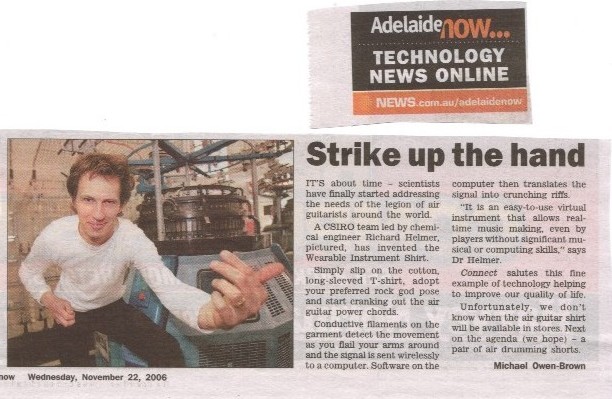
LATEST NEWS from AUSTRALIA


com´n air-heads
your time has come!

Thursday, November 16, 2006

NOVEMBER´s SHORT-CUT TICKET


As I mentioned before, they do it boys, tired of your dominant attitudes.

http://www.alarmare.se/index.php?info=viewCategory&id=2

But anyhow, I´ve never noticed that music/sound activities would be for men only..., many times I don´t understand the problem.
I think the problem is not mainly about music, it´s about something else, about how the society works.

http://drivemyguitar.blogspot.com/2006/04/they-are-coming.html

Sunday, November 12, 2006

WILLIAM GOES TO PICTURES

One day Williams´ aunt, Mrs Smith, dressed up like a Christmas tree, gave him a shilling for posting a letter for her and carrying her parcels from the grocer´s. - Buy some sweets or go to to the Pictures, she said as she gave it to him. As the Cinema ticket cost only sixpence, William bought som sweets with the other sixpence. He choose two bottles of Soda Pop and one cake of Chocolate of the Swiss brand.
Still he got a halfpenny twopence, if you count in Danish. William was not in the habit of going to the Picture Palaces. He had only been there once before in his life. It was an interesting programme.
First came the story of two guitar-thieves, who on coming out of a house full of semi-accoustic guitars were pursued by two policemen. They jumped on to a moving mystery train, and then jumped from that on to a moving easy rider motor-cycle, and from that they jumped into a moving jetplane.
The next play was a comedy, an American film. It began with a man playing guitar alone upstairs in his bedroom, but ended with a crowd of people, all covered with records and posters, falling downstairs on top of one another. It was awfully funny.
When the play was over, William hurried out of the Picture Palace and ran down the road, the lonesome road. He took a banana from his pocket and, using it as a pistol, fired twice. Two of his pursuers (not real ones!) fell dead, the rest came on. There was no time to be lost. Running for his dear life, he rushed down dead end street and, still looking back and firing as he went, he ran into his own gateway.
William´s father, Mr Smith, who had stayed at home that day because of a bad headache, after to many drinks a few hours earlier at China Bar, picked himself up from the middle of a rose-bush and seized William by back of his neck.
- What do you mean by running into me like that?!, he shouted.
- I was only just coming in at the gate, said William.
- Be quiet! And go to bed at once!

This story shows that William have a interest for guitar playing, but not too much opportunity to practise it himself. His father, Mr Smith, drink too much and Mrs. Smith, former top-model of the Vogue magazine, is kind but not really understanding, of the fact that William now is grown-up man. If kids are in the age of thirty-one, it´s not to late to learn them about the bird and the bees. But most important of all, they need guitars. Maybe Black, maybe mystery shaped.
In Europe they almost not make cheap mystery guitars any more, they come from the east. But quality can be amazingly good! (That was already said in the 1970-ies...)

Thursday, November 09, 2006

B L U E S Y


I hate to see
the evening sun go down
I hate to see
the evening sun go down
´Cause my baby
he done left this town
(St.Louis Blues)

Look here, sweet mama,
See what you have done,
You mad me love you, now your regular man done come.
(Trouble in mind)

It has been days, didn´t know your name
Why should I worry myself in vain
But now she´s gone, I don´t worry,
I´m sitting on top of the world.
(Sitting on Top of the World)

If you don´t like my ocean, don´t fish in my sea.
Stay out of my valley, let my mountain be.
(Don´t fish in my sea)

Born under a bad sign,
Been down since I began to crawl
If it wasn´t for bad luck,
You know, I wouldn´t have no luck at all.
(Born Under a Bad Sign)

Wednesday, November 08, 2006

FROM RUSSIA WITH LOVE ?


"Hi! I am Nina. To talk about my personal qualities I`l try to look at myself from aside. So I`m a romantic, charming, feminine, and sweet girl. Yet as a person I am open-minded, easy-going, kind-hearted. From the very beginning I try to behave naturally. I dislike lie and hypocrisy. Kindness and decency are the qualities that are very important for me and that`s why I value them in myself. I love my parents very much as they have given much to me and I am grateful to them. I have some questions for you if you want to get to know me closer: * Why are you interested in Russian lady? * Are you interested in serious relations with Russian woman? * I will be waiting for your reply to * Have you ever been to Russia? * Would you like to correspond or to talk by phone? * What is important for you in relations and am I right for you? * Are you planning to visit Russia? mailto: X X X
Hope you will tell me about yourself, kisses from Russia, Nina

I´m sorry Nina, this is not the way. I don´t like automatic love letters. Most of the advertising mail in the box is more unpersonal than yours, dangerous too, but ... one klick and my computer is invaded by some p-shop and gambling hostel activities. And you don´t seem to know about Alfred E. Neumann? Read what the comic book sez. And know some musical workshop like chewing gum. You must have some music talk if you make the walk. You are too far from the target. But I have some russian guitar music books, which reminds me; to cover it on this blog later. That´s the result of your automatic letter.

Sunday, November 05, 2006

Today: SOUND EFFECTS


"You can blow up the balloon in private and then let the air out in public, keeping the balloon hidden under your coat." That´s one classical trick ( used by balloonplayers).

I read in the Old Book, about William; "He couldn´t keep it blown up for ever. He had to let the air out som time. He couldn´t help it making noise when the air went out. It was the way it was made. He hadn´t made it. On his way to school he saw an old gentleman in the front of him. He blew up the balloon and held it under his Black-Rubber T-shirt. Then, as he passed the old gentleman, he let it off. The old gentleman gave a jump into the air and looked angrily around. He looked at the small innocent-looking, kick-boxing schoolboy, who was armed with 4 knifes and 2 shot-guns, and then at the upper windows of the houses.
The boy hurried on to the next gentleman. He had quite a happy walk to school. School was at first very succesful. But the mathematics master found the balloon and took it away from him. "I hope", said his father at lunch, "that they have taken away that balloon of yours". William replied sadly that they had"

From this story we can learn, don´t play with sound effects too much. If your amp for example have Reverb with stormy weather, destroy the world with no Delay, or Flanger with special danger, it could be better if you learn for example the C chord first. Ask your neighbour how to put your fingers (not in his wallet).

Thursday, November 02, 2006

New Hobby: SING ALONG WITH PICTURE !


Suggested songs

Can´t stop lovin you
The best things in life are free
Only you
It must have been love
Every breath you take
She loves you
All the things you are
We are the champions
Sunny Girl
(I can´t get no)Satisfaction
I just wanna make love to you
It´s a wonderful world
Can´t help falling in love
Let it be me
Hallelujah, I love her so
Man of Mystery
When a man loves a woman
Something
This Guy´s in Love with You
The song is you
He´s got the whole world in his hands


Do you know more? (suitable for your howlin and the guitar)
Let me know.

Sunday, October 29, 2006

OCTOBER´s SHORT-CUT TICKET


I´m in this area writing this. Bredgatan, Halmstad, to the left. Did like George Bush, used the Google and Googled in. It´s the magnetic town. I´ll never get out of here. Maybe it´s the doom for my sins,... or is it only cryptonite? (No Superman can stand cryptonite)..........Is this the next target?

Monday, October 23, 2006

You can do it...


...PLAY BASS
DAMMIT !

I liked this book immediately, straight on, modern. You don´t have to study for years to get started...., just do it.
With two CD:s and "it´s for real"- sounding exercises in different styles, soon touchable, with two hands and one head. I don´t complain at all when I find comments like this; "exessive use of this technique in your local music store will probably get you thrown out."
Matt Scharfglass is New-York based songwriter, bassist, guitarist and multi-instrumentalist. I can imagine that attitudes and tempo of living is high, demanding. How to deal with teenagers who want action directly? In New York?
Basslines are, as mentioned earlier, important in any music. With no Bass, no Punk or Funk. No Bach either. No Jazz, no Blues, no Woman, no Cry.
The bassplayer can be King or Queen of any group.
When you are used to good bassplayers, you always want to have it.
All upper voices "lean" on and/or are depending of the bassline When the the bass-instrument is missing, the lowest musical line performed automatically get´s the role of the bass. Any modern guitarplayer find info in bassbooks, guitarist and bassist often co-operate in rockgroups, making smashing grooves and riffs together.
More actual information may be found; http://www.musicsales.com

Sunday, October 15, 2006

HEY....it´s OCTOBER !

No September´s short-cut ticket...., it´s almost unforgiveable.
Latest busyness-news in English;
http://hvemsida.blogspot.com

Monday, September 25, 2006

LIFELINES


….of Jazz

In my own small history book, …is written the tiny notice; I talked with Ulf Wakenius for a few minutes in the phone about twentyfive years ago. The purpose was to check up why he didn´t join the suggested meeting for a interview in Gothenburg, at the locally well known cafe´ ”Brautigam” (I think this is the right spelling, BUT it can be Brudgums… or Bratwurst n´ Gum…or something else. You never know about the comical talents of the people in that town).
Ulf Wakenius said he had forgot the whole thing (been playing in a park). I then had heard Ulf Wakenius live a couple of times in guitarduo constellations, all of them impressive. In this particular record the artistry of ulf wakenius (Dragon Records 2002), the famous jazzpianoplayer Oscar Peterson mentions backcover; ”Tune for tune, I could only marvel at not only his musical dexterity, but more importantly to me, his deep roots into the true lifeline of jazz – the Blues.”
Just some years ago I heard Ulf on TV, in the Oscar Peterson group. I thought this was jazz guitar at it´s best – and it happens today.
On this record (picture) Ulf Wakenius morely does the soloperformance. Already in the opening number Have you met miss Jones?,... I immediately recongnized somebrazilpower…..as I said earlier….

-------------------------------------------
….or Classical

Gunnar Spjuth introduced classical guitar for me over thirty years ago. Looking in the mirror it was perfect. We were in the same age, the pieces of the puzzle over periods of guitar history were not delivered from above, from the ordentlicher highschuule-profezzor.
These recordings were done 1986 but digitally remastered in 2001.
Borrowed the CD from Hylte Folkbibliotek. Enjoyed the music right off, no thoughts about technical.
I always thought spanish pianopeices by Albenis and Granados were technically most comfortable for guitar duo…., but with a player like this,... why bother with social troubles....

Classical sologuitar, still in lead...... Details, all the work.

Sunday, September 03, 2006

BRAZILPOWER


" The Five Preludes of 1940. which vary in character, key, tempo and mode of playing, also show that the composer had not forgotten what he had learnt from the guitar-playing popular musicans" ( From the backcover of the LP "Julian Bream plays Villa-Lobos" - picture is part of the frontcover. It was realeased on RCA, recorded in England, I think in the early seventies. Heitor Villa-Lobos (1887-1959) is one of the world wide known composers of Brazilian music, and Julian Bream; one of the great inspired recording artist´s and messengers of our time in the field of classical guitar.
I have always felt that the recorded documents are of significant importance. More from the cover of this particular LP, about the composer Villa-Lobos; "Born in 1887 in Rio de Janeiro, he was only twelve years when he started playing in coffe-houses and, out of opposition to an academic type of tuition, gained his training on autodidactic basis. His actual "teachers" came from the ranks of popular musicians, who taught him guitar improvisations, melody and modulation of the "choro", a genre played in the open air by an instrumental ensemble". (Unfortunately I don´t have the name of the artist who did the frontcover picture, but I think it was extraordinary for the time, in the idiom of classical guitar. The text backside was written by Uwe Kraemer, in german, but also translated to english/ french.)
In my mind Brazil is one of the great music countries, and specially of course from the guitarists point of view. There is "everything"; the lyrical (some portugese...), black music (rhythm....),developed extended harmony, loved by jazz musicians. The three classical elements; "melody, rhythm and harmony". At least from geographical distance (I´ve never been outside Europe), it seems that all elements live happily together. The ethnic music is very vital, and influental, world known by it´s rhythmical chemistry. We even talk about brazilian footballplayers as artists of "samba-football".
Writer, guitarist and arrangeur Brian Hodel in an old article (Guitar - magazine, I think it was published in the late seventies) : "No account of Brazilian guitar music can omit Joao Gilberto. Though primarily a singer, it is his batida de samba (literally: "drumming on the guitar") which most Brazilian musicians consider the essence of the bossa-nova. Though many guitarists were working in the same direction, it was Joao with the 1958 succes of "Bim Bam" and "Desafinado" (A.C.Jobim), who popularized the style, and, along with Jobim, became the centre of a group of musicians inhabiting Rio´s Zona Sul who developed the bossa-nova into a definite form. (The Zona Sul is the southern part of Rio that includes the famed beach sections of Copacabana, Leblon and Ipanema.) Though the bossa-nova was never popular success in Brazil, it became so throughout most of the rest of the world beginning in the mid 60s. Why did the batida de vioalao revolutionize Brazilian guitar playing? As Baden Powell explains it: "Prior to this style of playing, samba was played with the entire right hand strumming up and down so that the guitarist had very little freedom to add a melody to the chords or a separate bass part. But the batida de violao allowed the guitarist to play like the classical performer with the right hand in position where it could function in more complex manner".
Fortunately I had the opportunity to experience Baden Powell in concert in Helsinki about thirty years ago. The headline in the newspaper the day after reported; "Happy Guitar (-ism or -playing; in finnish: "Onnellista Kitarointia") I agree, it was soft, cool, lyrical, rhythmical......, with amazing contact with the instrument and through that, with the audience. He didn´t talk too much, no jokes between the pieces..., he felt serious all the way. It was a full time solo performance, no group around him, which would make it easier to find the platforms of polyrhytmical grooves, when it´s needed. I´ll never know how much of his performance was improvised. (Good improvisers may sound like they play composed music all the way).

When studying the written music, for example arrangements of brazilian standards, it is important to remember; ..."what is written is not the whole truth". You must learn fundaments of the written idea properly,.. but then comes the question of of accents, understanding of the idiom, what freedom is possible to take and so on, like the more tutorial approach to jazz. You normally can´t play jazz themes like military music from southern Germany, and more less improvise over it that way, like Bobby the Robot (or "Raw Bath", from one Spike Jones record, it has nothing to do with my article)
Much of the modernism in the brazilian guitar, includes, beside the rhythmical essence, "mystical" chords ...., it´s part of it. Anyway, with some experience and finger playing conditions, it´s not so difficult "sound brazilian". It´s maybe compareable to, "it´s not diccult to sound "spanish". But then, from there, from the first humbug level........ Not so many decades ago it was not easy to find out, for example in northern Europe, how the stories go on. Thanks to the records of course, but also to the tutorial books, made by "insiders", much information is available.
In the case of studying brazilian guitar music, I occasionally some years ago found Nelson Faria´s book in music school library. It was very satisfying to read, and get some witness, and listening (CD included) to the small differencies involved in brazilian popular traditions. In Europe everything seemed to be just bossa-nova or samba...., sometimes even without that difference, "play some latin you idiot" (scene in restaurant ). For example; Nelson Faria gives examples of subivisions in the samba; Samba enredo, Samba cancao, Samba de breque, Partido alto, Batucada, Samba Funk. The Bossa Nova is of course something else. Beside that we have the Choro (many pieces are found in the older tradition and composition, sometimes also known by strictly classical guitarists). We also have other stylings as; Frevo and Baiao.
Nelson Faria also gives lot of names in selected discography and lists of important names in the different styles. One of the great brazilian guitar personalities mentioned is Laurindo (de) Almeida, highly important for the brazilian guitar links towards U.S. (since 1947). By occasion I happened to hear Laurindo Almeida with other (very) established musicians from the Los Angeles area, in 1970ies. This was in Malmoe (for swedish beer drinking readers; it´s in the same direction as your feet, if you lay down on the asphalt with your head in the direction of the north-pole). The performance was in a way, from the public point of view, very undramatic. My picture was that Laurindo Almeida&Co was meant to perform in Copenhagen, but by some positive reason also did it, with not flashingly much advertisement, in an small simple restaurant (with red-white chequered cloths and squeeking chairs) nearby.
I think that the written commercially available arrangements or compositions of Brazilian, at least influenced, have been important for the knowledge of Brazilian guitar over the world, not just the sounding records. In the european music and it´s educational traditions, the analyze, at least the possibility to do it, is often proof for establishment. It´s another story that classical music tradition (basically european) often offers more analyze than playing....
But the developed truth is, that brazilian guitar music have it all; rhythm..., harmony...., melody..... , in exciting combinations, on many levels. Music history is not only written in Europe. To understand polyrhythmic music, you must understand something (at least influences) of black music, if you understand less of this; you are more for the traditional european polyphonic room. I have nothing against it, but the polyrhythmic room gives one more dimension and greater freedom in voicing. It is also a matter of perspective, for example; are you playing in a group or not?

Carlos Barbosa Lima; " Jazz is the United State´s greatest contribution to the world music, a high mark in 20th century cultural life. Its African heritage has contributed significantly to its shape. The same heritage can be found in Caribbean and Brazilian music. The guitar is a part of many jazz ensembles and constantly featured as a solo instrument. The plectrum style was first developed for jazz and is still predominant, but since the 50´s, the more polyphonic "fingerstyle" has been widely absorbed into jazz an d other styles of American music, following the tradition established much earlier in Brazil. Inventive, artistic styles exist either way, with plectrum or fingers, so why not integrate all these styles at some point? " (from backcover, "MUSIC OF THE AMERICAS", Guitar Solo Publications/San Fransisco)


There are many reasons,.... later on,...to continue..... with..... BRAZILPOWER 2 !!!

Friday, August 11, 2006

AUGUST´s SHORT-CUT TICKET


Before I go blogging to Brazil…( hard times to get floating luggage on airplanes in Europe, ...by the way, anyway,... do it my way, ...this road is rocky but it want be rocky long, ... take me on a slow boat to China); it´s suitable to take up the question of style.

One common question, among young git-players; “what style should I prefer to get the opportunity to buy Pink Red Cadillac for Christmas”? The pro´s steady answer is, "try Bank Robbery." Use loose hair, masque and white gloves (from the bilberrypickin session).

But watch out, that can be the expensive method. As bars of fact show, it could be more expensive than the actual price at your favorite salesman in the backyard alley. The alternative way, choosing style, is to be natural. Show me one cat who need tattoos. Show me one cat who needs cowboy-hat, they already have nice hair-cut,... I mean hair-cat. They are already beautifully dressed up without shopping, ...have wonderful individual patterns, like finger prints (as Ginger, picture) and sleep when they want. ( And in no uncomfortable black rubber reptile dress!)

The key word is now PATTERN. Music is full of patterns, which leads in to styling. Each country or region have their patterns, in ethnic music it´s much about rhythm and accent in accompaniment. For example Brazil, motley as jungle.

picture from pingpad.blogspot.com